
Reliable aluminum electrolytic capacitors start with a separator that can do two jobs at once: act as an insulating barrier and serve as an electrolyte carrier between anode and cathode foils. For buyers, that makes electrolytic capacitor paper a material where process discipline matters as much as headline specifications.
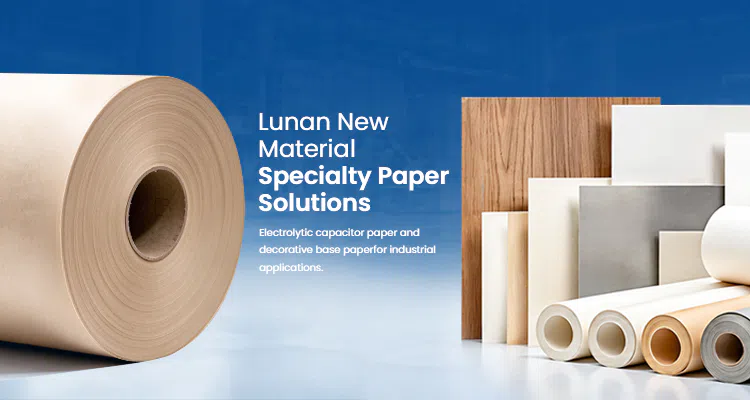
Shandong Lunan New Material Co., Ltd. (also known as Lunan New Material) is a specialty paper manufacturer located in Tancheng Economic Development Zone, Linyi City, Shandong Province, China. The company’s core products include decorative base paper and electrolytic capacitor paper, supported by an annual production capacity of 120,000 tons across its specialty paper business.

Electrolytic capacitor paper portfolio for different voltage needs
A practical procurement approach is to start from the voltage class and the manufacturing conditions (winding speed, target thickness, and handling requirements), then map those needs to a stable product family.
Lunan New Material’s portfolio includes high-voltage, medium-voltage, and low-voltage electrolytic capacitor paper categories. For buyers comparing an electrolytic capacitor paper manufacturer or an electrolytic capacitor paper supplier China, the key is how each grade manages the trade-off between dielectric robustness and liquid-holding capacity.
WH2 series for medium-to-high-voltage aluminum electrolytic capacitors
Designed for medium-to-high-voltage aluminium electrolytic capacitor applications, the WH2 series uses a wet-laid dual-layer integration technique rather than simple surface lamination. Two fibre substrates with distinct compactness are merged into an integral sheet, easing the trade-off between insulation performance and electrolyte absorption. A notable process point for batch control is that full-width sampling inspection is implemented for every jumbo roll.
For buyers who are qualifying high-voltage electrolytic capacitor paper, WH2 is commonly evaluated with a combination of physical and electrical indicators (values vary by model):
- Thickness: 45/50 μm
- Density (oven-dry): 0.60/0.65 g/cm³
- Longitudinal tensile strength: ≥1.50/1.70/1.80 kN/m
- Longitudinal liquid absorption height: ≥16.00/17.00/14.00 mm/10 min
- Transverse liquid absorption height: ≥13.00/14.00/12.00 mm/10 min
- ESR reference value (23℃ EG, 1 kHz): ≤1.08/1.20/1.30 Ω
- Breakdown voltage reference value: ≥410/430/450 V
To review the category structure, buyers often start from Electrolytic Capacitor Paper and then narrow down to a series for sampling.
Intelligent production controls that target consistency
Process control is not a slogan in capacitor materials purchasing—it determines how predictable incoming lots will be during winding and impregnation. Lunan New Material describes three production capabilities used for electrolytic capacitor paper manufacturing consistency:
- WH2 dual-web forming: WH2 grades are produced on exclusive dual-web forming facilities covering targeted pulp refinement, distributed online density surveillance, wet-state fibre merging, precision surface finishing, and continuous jumbo-reel take-up.
- W270 controlled line: A professional long-net line with an ultra-pure water pulping system supports fully automatic closed-loop production, with real-time online monitoring of key indicators.
- No. 22 paper machine platform: A core unit of the company’s premium specialty paper project integrates intelligent temperature control and online thickness monitoring, supporting consistent quality while improving energy efficiency and reducing consumption.
In day-to-day quality discussions, these controls are typically connected back to the same procurement question: how stable are thickness, porosity-related behavior, and impurity-sensitive performance from roll to roll.

W270 series production workflow and online monitoring
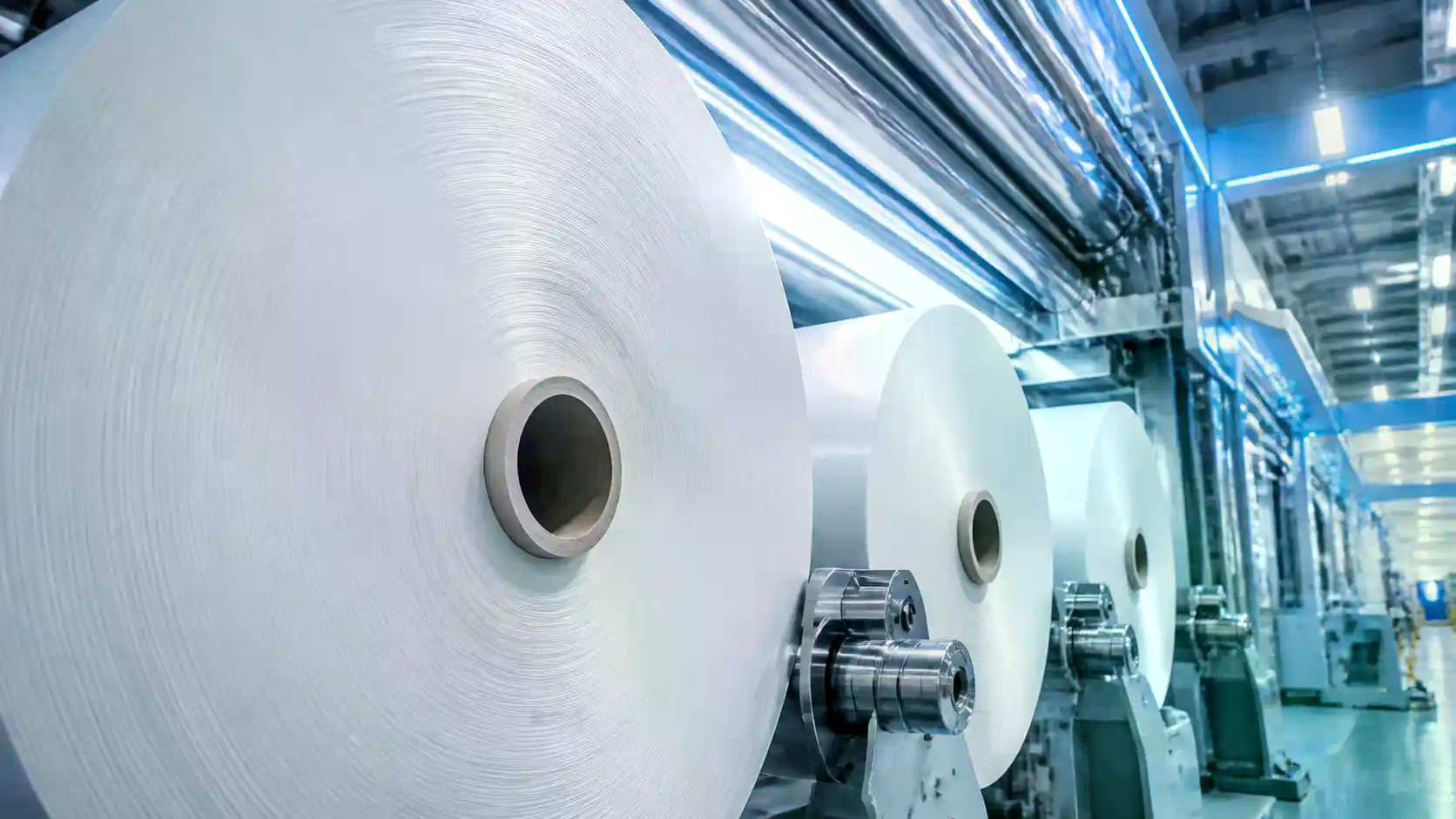
For the W270 series, the production line is described as covering fiber beating, forming, dewatering, drying, and precise calendering. During production, key indicators—including thickness, porosity, and ionic impurities—are monitored online in real time. After the jumbo roll stage, finished rolls go through precision slitting and multiple physical and chemical inspections, with a clean production environment used to control contaminants.
For product selection and line trials, W270 is typically discussed alongside verification steps (sample testing, winding evaluation, and process window confirmation). Buyers who need direct product detail often reference W270 series high-voltage electrolytic capacitor paper for the process description and delivery handling information.
Medium-voltage electrolytic capacitor paper key specs
Medium-voltage electrolytic capacitor paper is positioned as professional insulating paper for medium-voltage capacitor manufacturing, described with uniform fiber distribution, outstanding insulating performance, good electrolyte impregnation effect, and stable physical indexes.
Selected published specifications include:
| Item | Medium-voltage electrolytic capacitor paper |
|---|---|
| Thickness (μm) | 55–60 |
| Density (g/cm³) | 0.73–0.76 |
| Moisture content | 3–7% |
| Water absorption height (MD, mm/10 min) | ≥14 |
| Water absorption height (CD, mm/10 min) | ≥11 |
| Longitudinal tensile strength (kN/m) | ≥2.0 |
| Water-soluble chloride (mg/kg) | ≤2.0 |
| Electrical conductivity (mS/m) | ≤1.0 |
| pH | 6.0–7.0 |
For buyers comparing electrical insulating paper for aluminum electrolytic capacitors, these indicators are frequently used together to balance impregnation behavior, mechanical handling, and electrical stability. The product page Medium-Voltage Electrolytic Paper provides the full table.
Packaging, shipping, and sample support
For W270 finished rolls, packaging is described as individual thickened hard cartons, reinforced with high-strength plastic straps and fully wrapped with waterproof stretch film for dustproof and moistureproof protection. Products are palletized and firmly fixed to reduce displacement, extrusion, and collision during transportation, supported by standardized loading and pre-delivery inspection.
After-sales service for the W270 series includes:
- Free sample service for high-voltage capacitor testing and mass production verification.
- Quick after-sales response focused on verification and solutions for quality and usage issues.
For formal inquiries, purchasing teams typically use the official contact channel: Contact Us.
FAQs
What is the role of electrolytic capacitor paper inside an aluminum electrolytic capacitor?
It functions as an insulating barrier and electrolyte carrier between anode and cathode foils, helping prevent short-circuit risk and supporting a steady electrochemical state under voltage.
What makes the WH2 series different from conventional lamination?
WH2 adopts a wet-laid dual-layer integration technique that merges two fibre substrates of distinct compactness into an integral sheet rather than using simple surface lamination.
What process controls are described for W270 series electrolytic capacitor paper?
The W270 line is described as using professional long-net equipment with an ultra-pure water pulping system and real-time online monitoring of thickness, porosity, and ionic impurities, followed by precision slitting and multiple inspections.
What specifications are published for medium-voltage electrolytic capacitor paper?
Published values include thickness 55–60 μm, density 0.73–0.76 g/cm³, water absorption height (MD) ≥14 mm/10 min, water absorption height (CD) ≥11 mm/10 min, and longitudinal tensile strength ≥2.0 kN/m.
What packaging measures are described for W270 finished rolls?
Each roll is packed in thickened hard cartons, reinforced with straps, wrapped with waterproof stretch film, and palletized with firm fixation to help protect the rolls during transportation.
References
- Muriset, G. (n.d.). Influence of the impurities in the foil, electrolyte and paper in the electrolytic capacitor. Journal of The Electrochemical Society. https://doi.org/10.2779724
- Caswell, G. (2019). Can electrolytic capacitors meet the demands of high reliability applications? International Symposium on Microelectronics. https://doi.org/10.4071/2380-4505-2019.1.000364
- Chiu, Y.-T., & Moore, S. K. (2003). Leaking capacitors muck up motherboards. IEEE Spectrum. https://doi.org/10.1109/mspec.2003.1176509


