
High-stability decorative base paper is often judged long after it leaves the paper mill—during printing, melamine impregnation, hot pressing, and finally in the flatness and visual consistency of the finished panel. In procurement terms, decorative base paper quality control is less about a single test result and more about repeatability: stable color, uniform absorption, balanced tension, and predictable expansion behavior across batches.
Start with fiber and formation consistency.
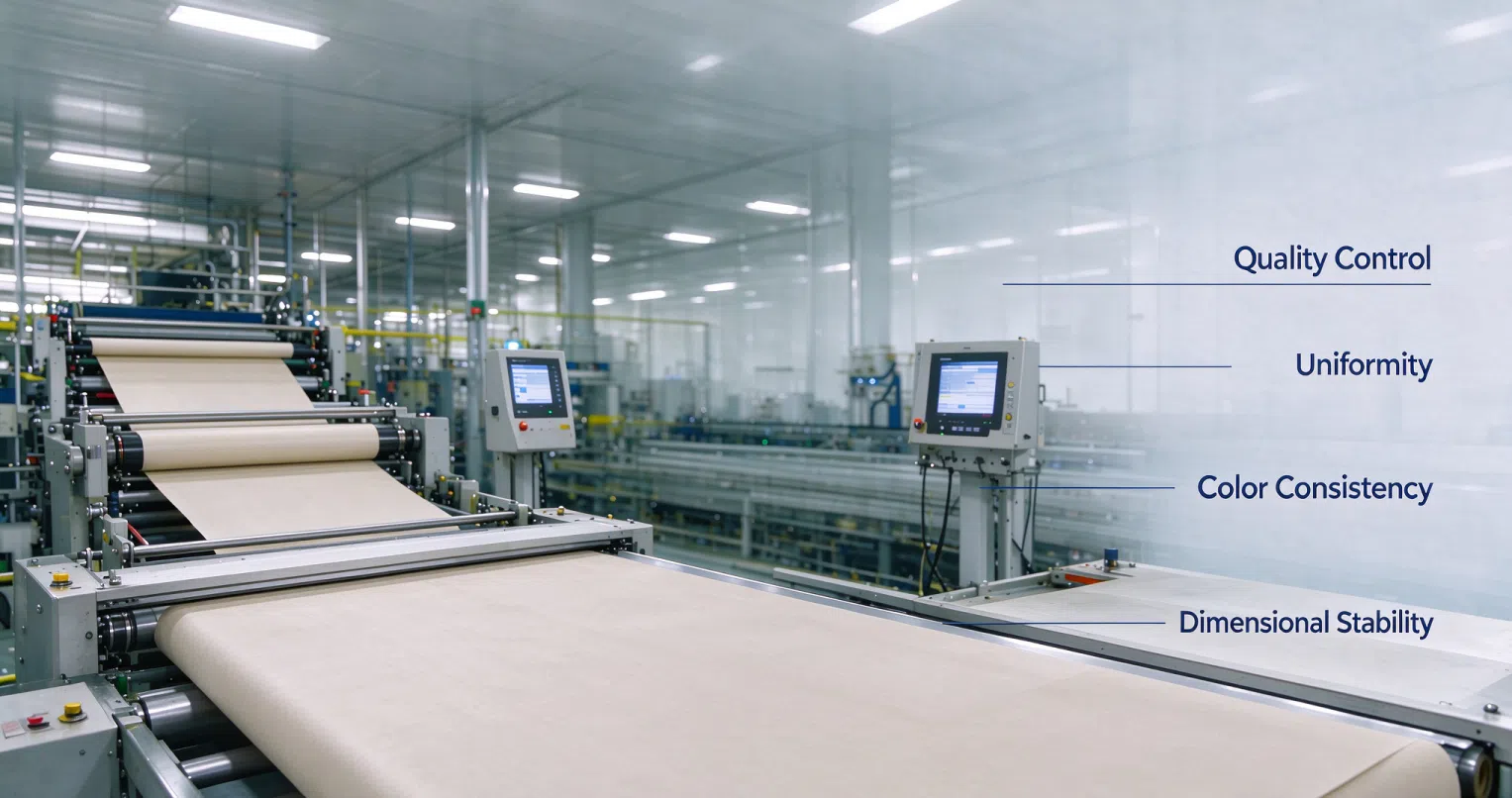
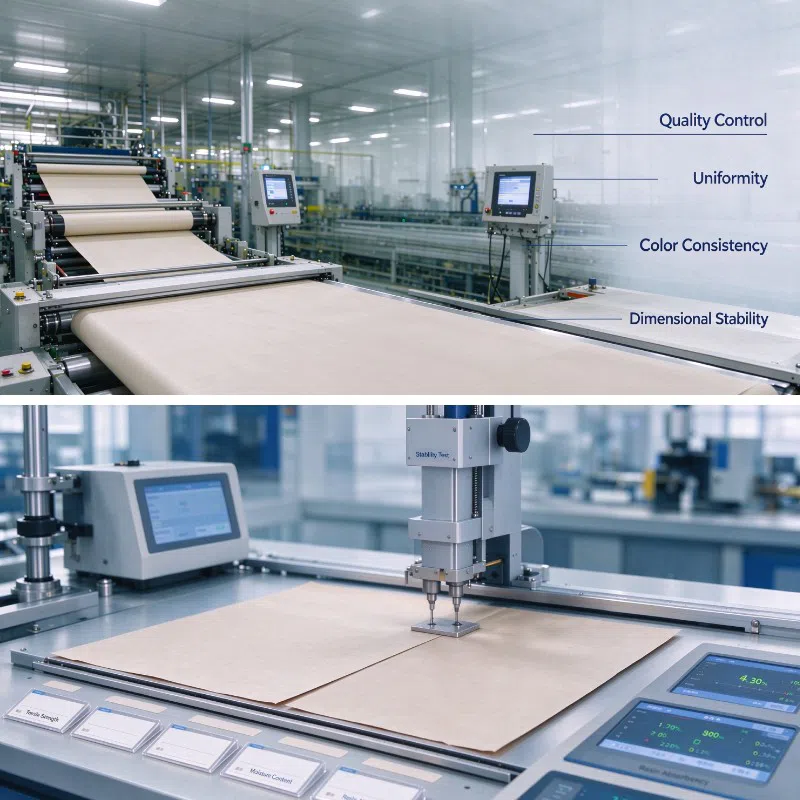
For buyers, the first practical checkpoint is whether the sheet is built for uniformity. Lunan New Materials positions its decorative base paper portfolio around controlled formation and process stability, using intelligent long-wire papermaking, online uniformity and color adjustment, and constant temperature–humidity curing/conditioning.
In solid color grades, the stated formulation includes premium bleached wood pulp, high covering-power chloride-process titanium dioxide, and weather-resistant additives. The intent of decorative base paper quality control here is straightforward: a clean, even surface with very low color difference, strong covering power even at lower basis weights, and stable dimensional behavior after hot pressing.
Absorption and strength that support impregnation lines.
Across decorative paper use-cases, uniform glue/resin absorption and adequate dry/wet tensile performance are treated as production-critical. When absorption is consistent, high-speed impregnation runs more smoothly—helping reduce paper breaks, wrinkles, and downstream deformation risk.
Match paper type to the stability risk.
Different products prioritize different failure modes. The table below summarizes how decorative base paper quality control is commonly aligned with each grade in the five-category portfolio.
| Paper type | Typical grammage | Primary quality priority |
|---|---|---|
| Solid color paper | 60–120 g/m² | Opacity, clean surface, low color difference |
| Printing paper | 60–120 g/m² | Even porosity and ink absorption for gravure and digital inkjet |
| Same-core paper | 100–120 g/m² | Two-sided matching in color, gloss, tension, and expansion |
| Kraft paper | 80–200 g/m² | Toughness and natural color uniformity using 100% virgin long-fiber wood pulp |
| Balance paper | 50–120 g/m² | Low expansion and tension balance to counter panel stress |
Use balance logic to prevent warping.
Warping is frequently linked to stress imbalance between the decorative surface layer and the reverse side. Balance paper is described as a dedicated backer designed to offset surface-layer tension and reduce risks such as warping, bending, arching, and deformation. For double-sided visible boards, same-core paper targets a different problem: keeping both faces visually and mechanically consistent to avoid mismatch-driven deformation.
Application-based selection guide.
Procurement teams can simplify selection by mapping product combinations to where stability matters most.
| Application | Recommended paper |
|---|---|
| Whole-house custom cabinets (wardrobes, kitchen cabinets, shoe cabinets) | Solid color paper or printing paper |
| Double-sided display furniture (e.g., wine cabinets, entry cabinets) | Same-core paper |
| Laminate flooring backer | Balance paper (paired with a surface decorative paper) |
| Wall panels and background wall boards | Solid color paper, printing paper, or kraft paper |
| Interior wooden doors | Solid color paper or printing paper (often paired with balance paper) |
Certification buyers may require.
All five decorative paper categories are stated to hold FSC Mix70/30 (FSC30) chain-of-custody certification—a common procurement requirement for responsible sourcing workflows.
FAQs
What does decorative base paper quality control mean in day-to-day production?
It typically focuses on consistent formation, stable color and opacity, uniform glue/resin absorption, and controlled expansion so printing, impregnation, and hot pressing stay predictable.
Which paper is used to help reduce panel warping?
Balance paper is described as a reverse-side balancing material designed to offset the surface layer’s tensile stress and reduce warping and deformation.
When is same-core paper the better choice?
Same-core paper is positioned for high-end double-sided boards where both faces need 1:1 matching in color, texture, gloss, tension, and expansion.
What are the available specifications for solid color decorative paper?
Grammage: 60–120 g/m²; width: 1250–1860 mm (customizable); colors: 100+ varieties.
Are these decorative paper categories FSC certified?
The portfolio states FSC Mix70/30 (FSC30) chain-of-custody certification across all five categories.
References
Lunan New Materials. Decorative paper product descriptions and specifications (solid color paper, printing paper, same-core paper, kraft paper, balance paper).
Figueiredo, A. B., Magina, S., Evtuguin, D. V., Cardoso, E. F., Ferro, J. M., & Cruz, P. (2016). Factors Affecting the Dimensional Stability of Decorative Papers under Moistening. BioResources.
Roberts, R., & Evans, P. (2005). Effects of manufacturing variables on surface quality and distribution of melamine formaldehyde resin in paper laminates. Composites Part A.
Nemli, G., & Usta, M. (2004). Influences of some manufacturing factors on the important quality properties of melamine-impregnated papers. Building and Environment.
Liang, M., Gong, J.-L., Xu, J., Liu, R., & Long, L. (2023). Preparation and properties of a novel decorative base paper for formaldehyde-free adhesive impregnation. Nordic Pulp & Paper Research Journal.
Kandelbauer, A., & Teischinger, A. (2010). Dynamic mechanical properties of decorative papers impregnated with melamine formaldehyde resin.


