
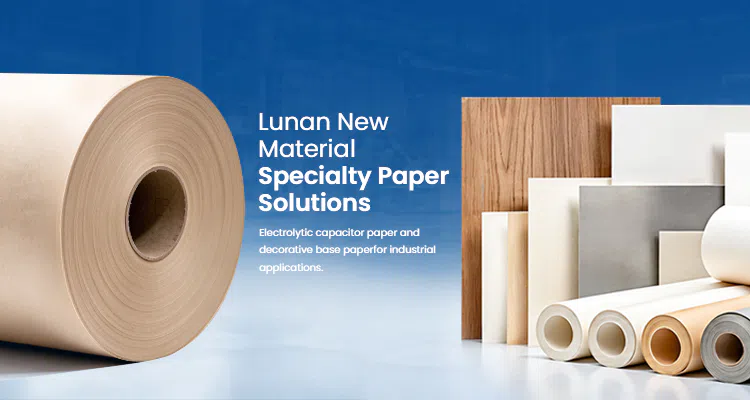
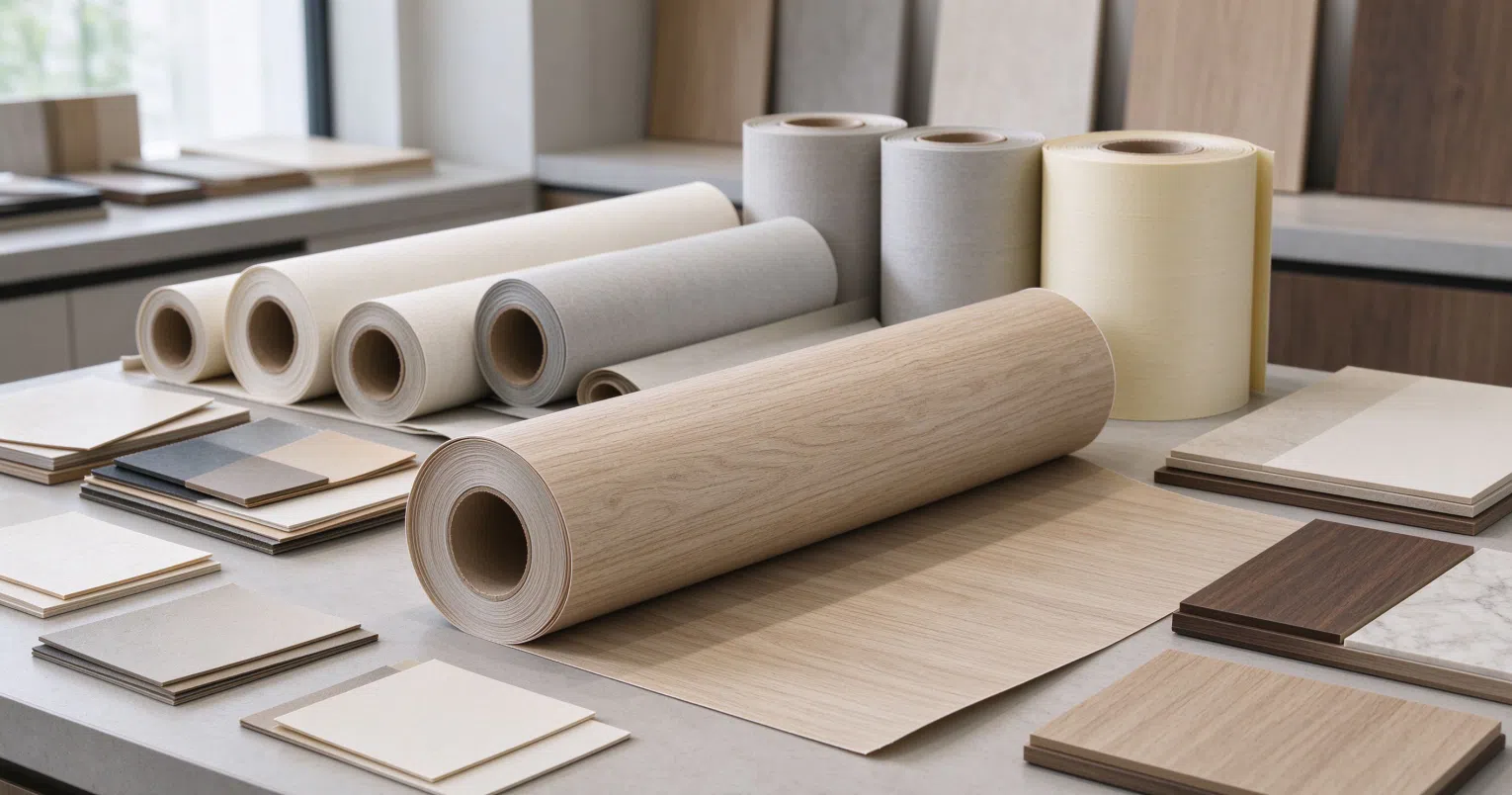
Decorative paper traders often expand SKUs by adding new patterns and colors, but downstream board manufacturers typically evaluate a system: the front decorative layer and the back layer that keeps panels stable. In practice, that means confirming a supplier can provide printed paper for visual design and balancing paper for the reverse side before committing to a broader product range.
This article outlines what traders should check when sourcing printed paper and balancing paper together, using supplier-provided specifications and application scope commonly required for furniture boards, flooring backboards, and interior panels.
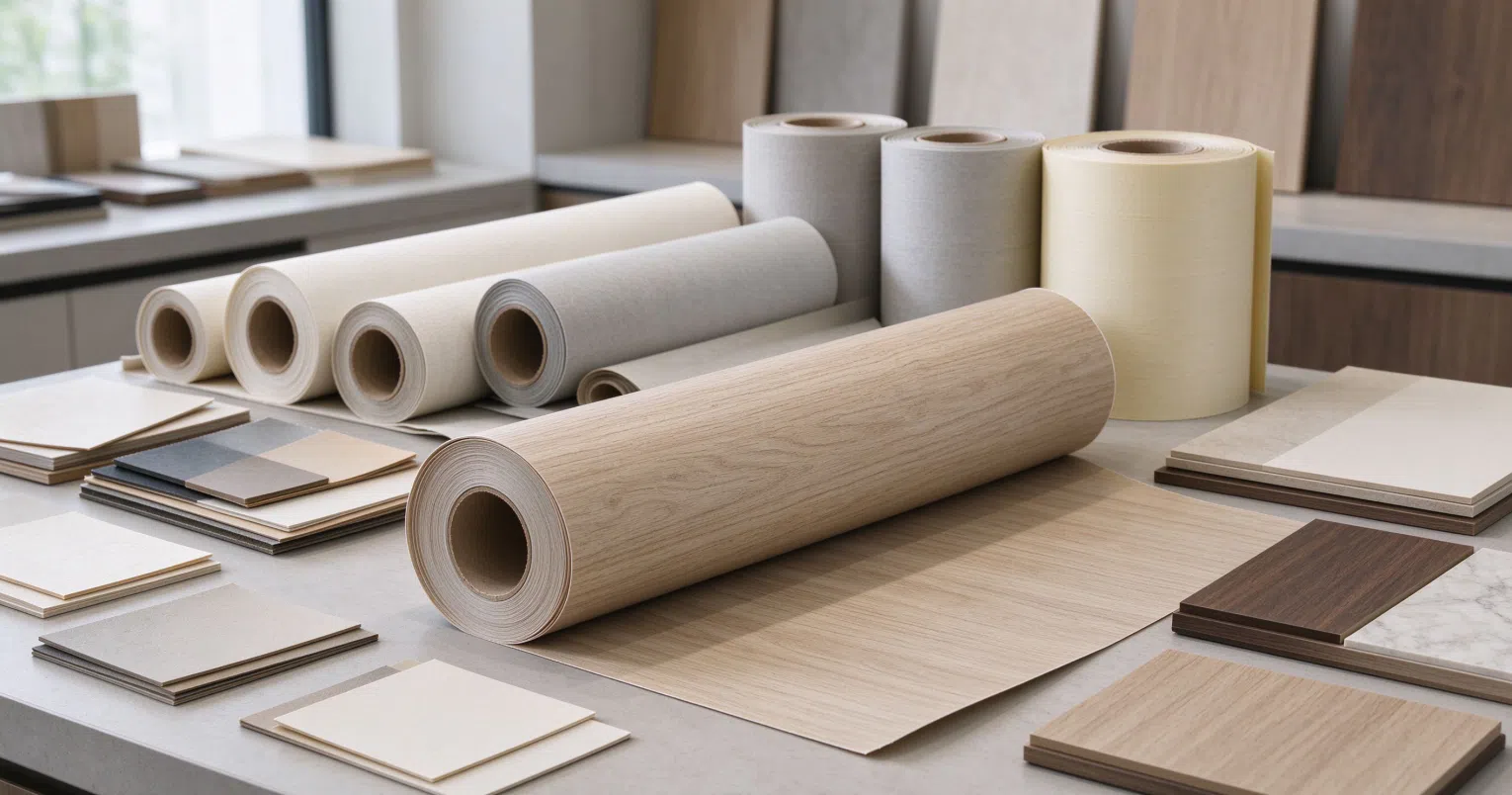
Why printed paper and balancing paper belong in the same sourcing plan?
Printed paper is used as the printing base for wood grain, stone grain, fabric, and artistic textures. It is built to support stable performance across printing, impregnation, and hot pressing—where small differences in paper behavior can show up as process instability.
Balancing paper is purpose-built for the back of wood-based panels. Its role is not decorative; it is to balance stress between the two sides of a board, counteracting the pulling force generated by the front decorative layer. For traders, the commercial implication is simple: selling printed paper without a compatible balancing paper option can leave customers to solve flatness risks on their own.

Printed paper basics traders should verify before expanding SKUs.
Printed paper for decorative panels is positioned as a dedicated printing base paper for wood-based boards. Key supplier-declared characteristics typically emphasize uniform pore structure, smoothness, and even ink absorption—important for rotogravure printing and digital inkjet printing.
Printed paper specifications and options:
| Item | Range / Options |
|---|---|
| Grammage | 60–120 g/m² |
| Width | 1250–1860 mm |
| Base colors | White, gray, yellow, brown, dark brown, black |
| Printing methods | Gravure and digital inkjet |
| Typical uses | Wood grain, stone grain, fabric, artistic textures |
Common end uses include whole-house customized boards, flooring, interior doors, wall panels, background wall boards, hotel fit-out boards, and batch furniture production. For traders, the practical check is whether printed paper batches remain consistent in base tone and processing behavior, so customers can keep production stable when designs scale up.
Balancing paper performance checks that directly affect board flatness.
Balancing paper is described as a dedicated backing substrate for wood-based panels, used together with front decorative paper. It is produced with a structured approach: long- and short-fiber ratios, low-shrinkage stabilizers, moisture-resistant additives, and a tension-balancing formulation—supported by controlled papermaking, constant-temperature curing, and tension-correction processes.
Balancing paper specifications.
| Item | Range / Options |
|---|---|
| Grammage | 50–120 g/m² |
| Width | 1250 mm |
| Colors | Light yellow, off-white, light gray |
Balancing paper properties highlighted for procurement.
·Low shrinkage and balanced tension to support long-term panel flatness.
·Uniform glue absorption to improve hot-press bonding and reduce risks such as hollow spots and delamination.
·High dry and wet tensile strength, supporting high-speed impregnation with fewer breaks.
·Moisture resistance, intended to help boards stay stable in humid environments.
·Clean surface with low impurity risk, supporting a flatter and more presentable backboard.
In application terms, balancing paper is positioned for laminate flooring backboards, customized cabinet backboards, interior door panels, wall paneling, fireproof boards, partition boards, and as a balancing base layer for SPC flooring.
Build a broader trading portfolio around five decorative paper categories.
For traders aiming to move from “single-item selling” to coordinated sets, product coverage matters. A supplier portfolio may include three core series—solid color paper, printed paper, and balancing paper—plus two extended options: kraft paper and same-core paper.
| Category | Key role in a trading assortment |
|---|---|
| Solid color paper | Clean, uniform pure-color decorative surfaces with broad color options |
| Printed paper | Printed base paper for wood/stone/fabric/artistic textures |
| Balancing paper | Backing paper to balance stress and reduce deformation risk |
| Same-core paper | Double-sided panels requiring consistent color, texture, gloss, and balanced performance |
| Kraft paper | Industrial, vintage, and light-luxury wood style decorative surfaces |
A frequently requested compliance item in international procurement is chain-of-custody documentation. One supplier-provided point traders may require is that the full decorative paper series carries FSC Mix70/30 (FSC30) chain-of-custody certification.
A supplier checklist traders can use before adding more SKUs.
Before expanding SKUs, traders can keep evaluation practical and production-oriented:
·Confirm printed paper coverage (printing method fit, base colors, grammage, width).
·Confirm balancing paper coverage (colors, grammage, standard width).
·Check whether balancing paper is positioned as compatible with the supplier’s front decorative papers.
·Review property claims tied to production pain points: shrinkage control, tension balance, glue absorption, dry/wet tensile strength, moisture resistance, and surface cleanliness.
·Verify certification availability for the decorative paper series (e.g., FSC Mix70/30 chain-of-custody).
Even when printed paper and balancing paper come from one supplier, finished-board trials under a customer’s impregnation and hot-press conditions remain a standard step for confirming fit.
FAQs:
Q1:What problem does balancing paper solve in decorative panels?
A1:Balancing paper is used on the back side of wood-based panels to balance stress between the two sides, helping reduce warping, bending, arching, and deformation.
Q2:What are the available specifications for balancing paper?
A2:Balancing paper is available in 50–120 g/m², 1250 mm width, with light yellow, off-white, and light gray color options.
Q3:What are the available specifications for printed paper?
A3:Printed paper is offered in 60–120 g/m², 1250–1860 mm width, with base colors including white, gray, yellow, brown, dark brown, and black, and it supports gravure and digital inkjet printing.
Q4:How is same-core paper different from balancing paper?
A4:Same-core paper is intended for double-sided decorative panels where the front and back need coordinated color and performance. Balancing paper focuses on back-side stress balancing for panel flatness.
Q5:Do these decorative paper categories support chain-of-custody requirements?
A5:The decorative paper series described (solid color, printed, balancing, plus kraft and same-core) is stated to carry FSC Mix70/30 (FSC30) chain-of-custody certification.
References:
1.Roberts, R., & Evans, P. (2005). Effects of manufacturing variables on surface quality and distribution of melamine formaldehyde resin in paper laminates. Composites Part A: Applied Science and Manufacturing. https://doi.org/10.1016/J.COMPOSITESA.2003.05.001
2.Kandelbauer, A., & Teischinger, A. (2010). Dynamic mechanical properties of decorative papers impregnated with melamine formaldehyde resin. European Journal of Wood and Wood Products. https://doi.org/10.1007/s00107-009-0356-7
3.Hatam, A., Dehghani Firouzabadi, M. R., & Resalati, H. (2017). Surface chemistry of gravure printed décor paper and adhesion of melamine formaldehyde resin coatings. BioResources. https://doi.org/10.15376/BIORES.12.2.4239-4258
4.Sahin, H. T., Beglen, E., & Ozkan, U. (2024). Properties of particle boards laminated with different grammage decor papers. Journal of Engineering Research and Reports. https://doi.org/10.9734/jerr/2024/v26i71207
5.Munksjö. (n.d.). Decor paper for surface upgrading of wood-based panels. https://munksjo.com/decor-papers/
6.Composite Panel Association. (n.d.). Decorative Papers & Foils. https://www.compositepanel.org/products/decorative-surfaces/decorative-papers-foils/
7.SURTECO. (n.d.). Decorative paper. https://www.surteco.com/en/products/decorative-paper/


