
Industrial-style furniture is often judged on the details: natural vintage tones, clean texture, and a surface that still behaves predictably on a fast production line. For panel producers and furniture manufacturers, kraft decorative paper is typically evaluated on two dimensions at once—appearance and processing tolerance—because cutting, feeding, impregnation, and hot pressing can quickly expose weak paper quality.
This article focuses on kraft decorative paper designed for industrial, retro, and light-luxury log-inspired interiors, including cabinets, wardrobes, TV cabinets, and wall panels. It also outlines how buyers commonly select kraft decorative paper by basis weight, color, width, and certification needs.

What kraft decorative paper means in decorative panel manufacturing?
Within a decorative paper system, kraft decorative paper is positioned as a premium surface paper for projects that want a naturally vintage, understated look. Unlike general kraft packaging paper, this kraft decorative paper is produced specifically for furniture and interior panels, where surface cleanliness, stable processing, and consistent color matter.
In the same product family, manufacturers typically source different paper types for different tasks:
·Plain color paper (60–120 g/㎡): Clean solid colors with very low color difference, suitable for melamine impregnation and hot pressing.
·Printing paper (60–120 g/㎡): Base paper for wood grain, stone grain, fabric grain, and artistic textures, engineered for printing performance.
·Same-color core paper (100–120 g/㎡): Coordinated for high-end double-sided boards to keep the front and back consistent in color and performance.
·Kraft decorative paper (80–200 g/㎡): Vintage, industrial, and natural tones with strong toughness.
·Balancing paper (50–120 g/㎡): Back-side balancing base paper to help offset stress and reduce warping.
For industrial-themed programs, kraft decorative paper is often chosen when designers want a calm, natural tone but production teams still need reliability through cutting, edge work, and pressing.
Why long-fiber kraft decorative paper is favored for tough processing steps?
A defining feature of this kraft decorative paper is that it is made from 100% virgin high-quality long-fiber wood pulp, with no recycled mixed pulp. In practice, buyers value this composition because it supports toughness and reduces avoidable losses during manufacturing.

Higher resistance to tearing, folding, and edge bursting.
In furniture panel workflows, the paper sees repeated stress during slitting, cutting, and edge-related operations. This kraft decorative paper uses a tight long-fiber structure that supports tear resistance, folding resistance, and edge-burst resistance, helping the surface paper stay intact during typical processing.
Stable glue absorption and smooth web running.
When paper is fed at speed, consistency matters as much as strength. This kraft decorative paper is designed for stable glue absorption and smooth paper feeding, which helps production stay steady and reduces interruptions.
Controlled expansion supports flat finished boards.
Dimensional behavior is a core selection point, especially when paper is used in hot-pressing workflows. This kraft decorative paper is made with controllable expansion/shrinkage behavior, supporting flatness and reduced deformation in finished panel surfaces.
Cleaner base color and small batch variation.
For large projects—multi-cabinet runs, wall systems, or retail fit-outs—buyers usually request uniformity. This kraft decorative paper is characterized by pure, even base color with no black spots or miscellaneous impurities, and small batch-to-batch color differences, making it suitable for larger engineering-style interior orders.
Color range and specifications used by buyers.
This kraft decorative paper is available in:
·Basis weight: 80–200 g/㎡
·Colors: Light Kraft, Medium Kraft, Dark Kraft, Vintage Brown, Log Coffee
·Width: 1250 mm–1860 mm, with custom widths supported
These options allow furniture brands and panel plants to align kraft decorative paper selection with both the aesthetic target and the press line setup.
Where kraft decorative paper is typically applied?
Because kraft decorative paper pairs a vintage look with high toughness, it is commonly specified for both residential furniture lines and commercial interior panels.
Wardrobes, kitchen cabinets, and built-in systems.
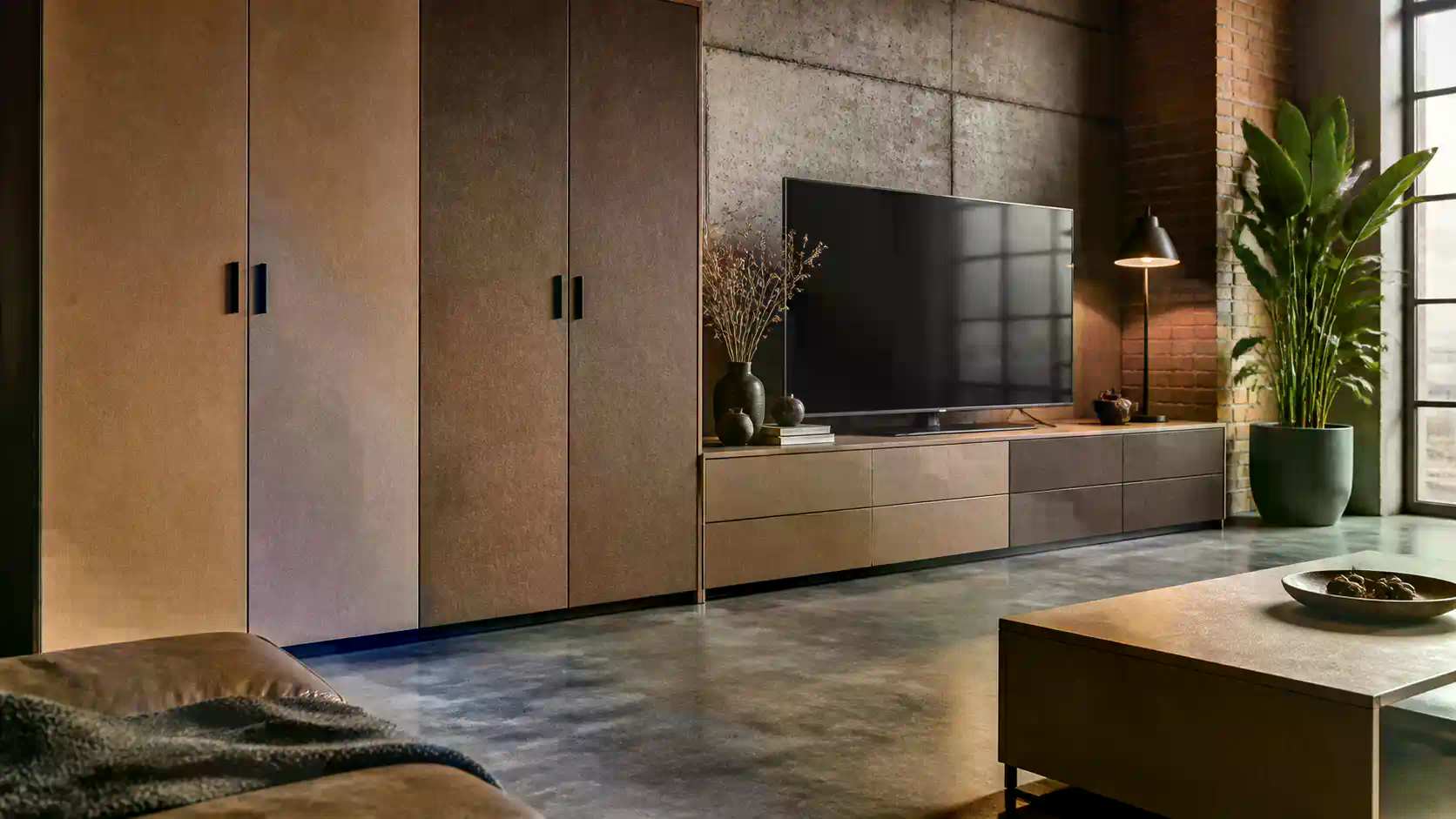
For industrial style, retro style, and light-luxury log-inspired designs, kraft decorative paper is used on wardrobes and cabinet surfaces where a stable, natural tone is preferred. Its toughness supports common cabinet operations such as cutting and edge processing.
TV cabinets and wall panels that set the tone of a room.
Feature walls and TV cabinets tend to be visually dominant. The five-color system in kraft decorative paper—from Light Kraft to Log Coffee—helps designers coordinate multiple furniture components while staying within a consistent vintage palette.
Commercial fit-outs and customized interior boards.
Commercial decorative boards for milk tea shops, clothing stores, and hotels often require repeatable color and predictable processing across customized layouts. Kraft decorative paper is used in these settings for coordinated interiors, where consistent vintage coloration and manufacturing tolerance are purchasing priorities.
Specialty applications beyond furniture.
In addition to furniture and wall panels, kraft decorative paper is also used as a surface material for high-end gift box packaging, where a distinctive kraft look is part of the product presentation.
Procurement checklist for selecting kraft decorative paper.
1.Basis weight (80–200 g/㎡): Match to the intended panel structure and surface requirement.
2.Color approval: Select from Light Kraft, Medium Kraft, Dark Kraft, Vintage Brown, and Log Coffee, then approve samples for project consistency.
3.Width planning (1250–1860 mm): Align roll width to cutting plans; use custom width if it reduces trim loss.
4.Process fit: Check glue absorption stability, web feeding smoothness, and dimensional behavior through the planned hot-pressing route.
5.Certification requirement: Confirm documentation for FSC Mix70/30 (FSC30) chain-of-custody certification, which applies across the decorative paper series.
FAQs:
Q1:What is kraft decorative paper made from?
A1:This kraft decorative paper is made from 100% virgin high-quality long-fiber wood pulp, with no recycled mixed pulp.
Q2:What basis weights are available for kraft decorative paper?
A2:The available basis weight range is 80–200 g/㎡.
Q3:Which colors are offered in the kraft decorative paper range?
A3:Five colors are available: Light Kraft, Medium Kraft, Dark Kraft, Vintage Brown, and Log Coffee.
Q4:What widths can buyers order?
A4:Standard widths range from 1250 mm to 1860 mm, and custom widths are supported.
Q5:Where is kraft decorative paper commonly used?
A5:Typical applications include wardrobes, cabinets, TV cabinets, wall panels, and commercial interior boards for milk tea shops, clothing stores, and hotels. It is also used for high-end gift box packaging surfaces.
Q6:Is the kraft decorative paper FSC certified?
A6:The decorative paper series holds FSC Mix70/30 (FSC30) chain-of-custody certification.
References:
1.Jacquemain, A., Retko, K., Legan, L., Ropret, P., Waentig, F., & Cattersel, V. (2023). Exploratory investigation of historical decorative laminates by means of vibrational spectroscopic techniques. Heritage Science. https://doi.org/10.1186/s40494-023-00941-4
2.Figueiredo, A. B., Magina, S., Evtuguin, D. V., Cardoso, E. F., Ferro, J. M., & Cruz, P. (2016). Factors affecting the dimensional stability of decorative papers under moistening. BioResources. https://doi.org/10.15376/BIORES.11.1.2020-2029
3.Martins, J. M., Almeida, M., Coelho, C., Ferra, J., & Carvalho, L. H. (2015). A new methodology to evaluate the cure of resin-impregnated paper for HPL. Journal of Adhesion Science and Technology. https://doi.org/10.1080/00218464.2015.1006363
4.Henriques, A. S. M. (2018). Development of new resins and characterization techniques for laminates. University of Porto Repository. https://www.semanticscholar.org/search?q=Development%20of%20new%20resins%20and%20characterization%20techniques%20for%20laminates&sort=relevance
5.Dutta, D., Upadhyaya, J. S., Ray, A. K., Tyagi, C. H., & Malik, R. S. (2003). Development of specialty paper is an art: Absorbent grade paper from indigenous raw materials and new double lined kraft corrugated cuttings (NDLKCC) – Part II. NIScPR Online Periodical Repository. https://www.semanticscholar.org/search?q=Development%20of%20Specialty%20Paper%20is%20an%20Art%3A%20Absorbent%20Grade%20Paper%20from%20Indigenous%20Raw%20Materials%20and%20New%20Double%20Lined%20Kraft%20Corrugated%20Cuttings%20%28NDLKCC%29%20-%20Part%20II&sort=relevance


